 Add to Chrome
 Add to Firefox
 Add to Edge
From GPS Points to Travel Patterns: Flexible and Semantic Trajectory Generation with LLMs
May 28, 2026
Urban trajectories play a crucial role in modeling urban dynamics and supporting various smart city applications. However, privacy concerns restrict access to large-scale and high-quality trajectory datasets. Trajectory generation provides a promising alternative by synthesizing realistic data to mitigate privacy risks. However, existing methods fail to explicitly capture travel patterns and can only generate fixed-length trajectories under a single condition. To address these limitations, we propose \textbf{HTP}, which \textbf{H}ierarchically generates \textbf{T}ravel patterns first and then generates GPS \textbf{P}oints by using large language models (LLMs), rather than directly generating GPS points. We first design a trajectory-specific residual quantization variational autoencoder (RQ-VAE) that quantizes micro-level GPS trajectories into compact, macro-level travel pattern tokens in a coarse-to-fine manner. These tokens capture rich segment spatial irregularities, such as point density variations caused by traffic conditions. Then, we extend the LLM vocabulary with travel pattern tokens to align trajectory representations with the LLM input, and apply supervised fine-tuning (SFT) to align the LLM with the trajectory generation task, enabling generation of travel pattern sequences under various conditions. Extensive experiments on two real-world datasets show that HTP outperforms the strongest baseline by an average of 29.78\% in terms of generation quality. Our code is available at https://github.com/slzhou-xy/HTP.

Hy-MT2: A Family of Fast, Efficient and Powerful Multilingual Translation Models in the Wild
May 21, 2026Hy-MT2 is a family of fast-thinking multilingual translation models designed for complex real-world scenarios. It includes three model sizes: 1.8B, 7B, and 30B-A3B (MoE), all of which support translation among 33 languages and effectively follow translation instructions in multiple languages. For on-device deployment, with AngelSlim 1.25-bit extreme quantization, the 1.8B model requires only 440 MB of storage and improves inference speed by 1.5x. Multi-dimensional evaluations show that Hy-MT2 delivers outstanding performance across general, real-world business, domain-specific, and instruction-following translation tasks. The 7B and 30B models outperform open-source models such as DeepSeek-V4-Pro and Kimi K2.6 in fast-thinking mode, while the lightweight 1.8B model also surpasses mainstream commercial APIs from providers such as Microsoft and Doubao overall.
Efficient Model-Agnostic Continual Learning for Next POI Recommendation
Nov 12, 2025Next point-of-interest (POI) recommendation improves personalized location-based services by predicting users' next destinations based on their historical check-ins. However, most existing methods rely on static datasets and fixed models, limiting their ability to adapt to changes in user behavior over time. To address this limitation, we explore a novel task termed continual next POI recommendation, where models dynamically adapt to evolving user interests through continual updates. This task is particularly challenging, as it requires capturing shifting user behaviors while retaining previously learned knowledge. Moreover, it is essential to ensure efficiency in update time and memory usage for real-world deployment. To this end, we propose GIRAM (Generative Key-based Interest Retrieval and Adaptive Modeling), an efficient, model-agnostic framework that integrates context-aware sustained interests with recent interests. GIRAM comprises four components: (1) an interest memory to preserve historical preferences; (2) a context-aware key encoding module for unified interest key representation; (3) a generative key-based retrieval module to identify diverse and relevant sustained interests; and (4) an adaptive interest update and fusion module to update the interest memory and balance sustained and recent interests. In particular, GIRAM can be seamlessly integrated with existing next POI recommendation models. Experiments on three real-world datasets demonstrate that GIRAM consistently outperforms state-of-the-art methods while maintaining high efficiency in both update time and memory consumption.
Hunyuan-TurboS: Advancing Large Language Models through Mamba-Transformer Synergy and Adaptive Chain-of-Thought
May 21, 2025As Large Language Models (LLMs) rapidly advance, we introduce Hunyuan-TurboS, a novel large hybrid Transformer-Mamba Mixture of Experts (MoE) model. It synergistically combines Mamba's long-sequence processing efficiency with Transformer's superior contextual understanding. Hunyuan-TurboS features an adaptive long-short chain-of-thought (CoT) mechanism, dynamically switching between rapid responses for simple queries and deep "thinking" modes for complex problems, optimizing computational resources. Architecturally, this 56B activated (560B total) parameter model employs 128 layers (Mamba2, Attention, FFN) with an innovative AMF/MF block pattern. Faster Mamba2 ensures linear complexity, Grouped-Query Attention minimizes KV cache, and FFNs use an MoE structure. Pre-trained on 16T high-quality tokens, it supports a 256K context length and is the first industry-deployed large-scale Mamba model. Our comprehensive post-training strategy enhances capabilities via Supervised Fine-Tuning (3M instructions), a novel Adaptive Long-short CoT Fusion method, Multi-round Deliberation Learning for iterative improvement, and a two-stage Large-scale Reinforcement Learning process targeting STEM and general instruction-following. Evaluations show strong performance: overall top 7 rank on LMSYS Chatbot Arena with a score of 1356, outperforming leading models like Gemini-2.0-Flash-001 (1352) and o4-mini-2025-04-16 (1345). TurboS also achieves an average of 77.9% across 23 automated benchmarks. Hunyuan-TurboS balances high performance and efficiency, offering substantial capabilities at lower inference costs than many reasoning models, establishing a new paradigm for efficient large-scale pre-trained models.
Empowering Edge Intelligence: A Comprehensive Survey on On-Device AI Models
Mar 08, 2025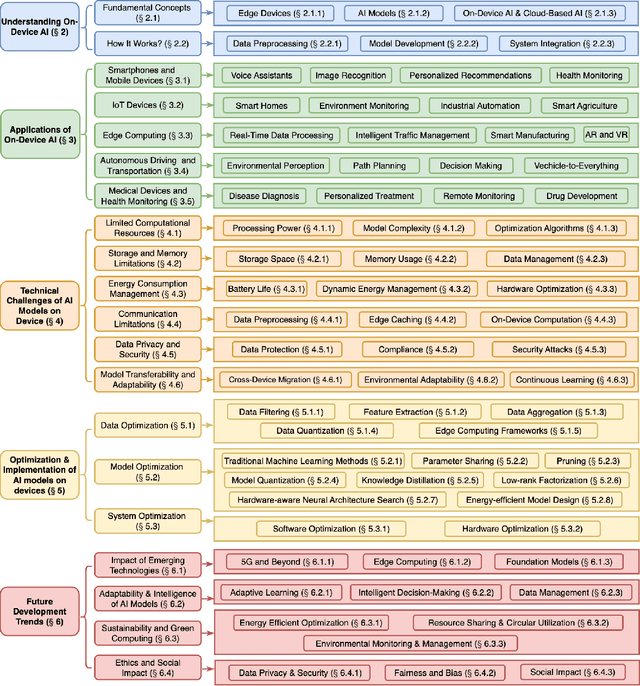
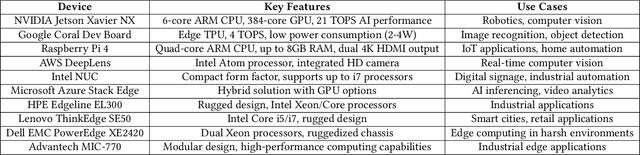


The rapid advancement of artificial intelligence (AI) technologies has led to an increasing deployment of AI models on edge and terminal devices, driven by the proliferation of the Internet of Things (IoT) and the need for real-time data processing. This survey comprehensively explores the current state, technical challenges, and future trends of on-device AI models. We define on-device AI models as those designed to perform local data processing and inference, emphasizing their characteristics such as real-time performance, resource constraints, and enhanced data privacy. The survey is structured around key themes, including the fundamental concepts of AI models, application scenarios across various domains, and the technical challenges faced in edge environments. We also discuss optimization and implementation strategies, such as data preprocessing, model compression, and hardware acceleration, which are essential for effective deployment. Furthermore, we examine the impact of emerging technologies, including edge computing and foundation models, on the evolution of on-device AI models. By providing a structured overview of the challenges, solutions, and future directions, this survey aims to facilitate further research and application of on-device AI, ultimately contributing to the advancement of intelligent systems in everyday life.
LINKED: Eliciting, Filtering and Integrating Knowledge in Large Language Model for Commonsense Reasoning
Oct 12, 2024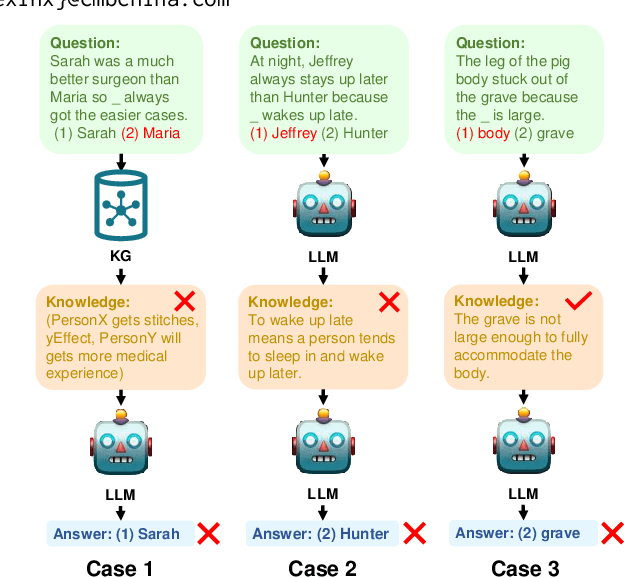
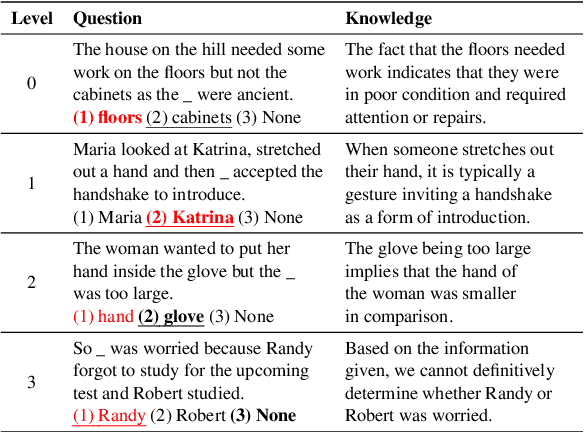
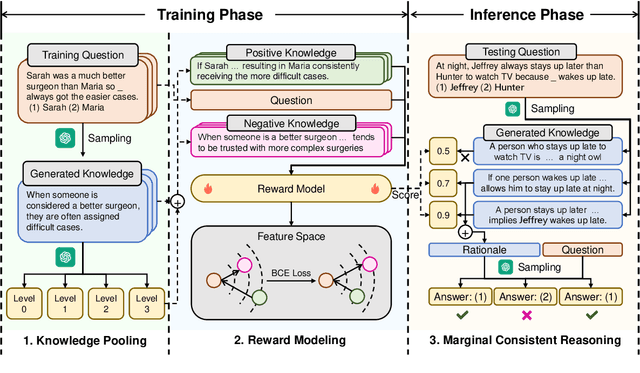
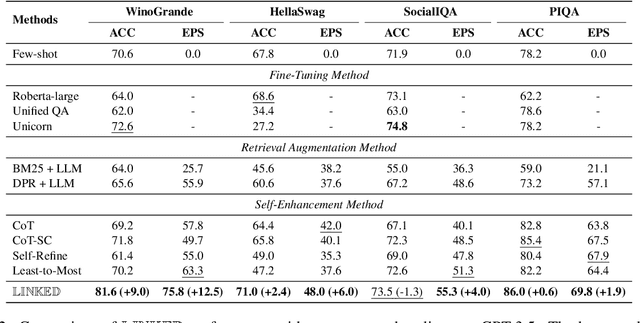
Large language models (LLMs) sometimes demonstrate poor performance on knowledge-intensive tasks, commonsense reasoning is one of them. Researchers typically address these issues by retrieving related knowledge from knowledge graphs or employing self-enhancement methods to elicit knowledge in LLMs. However, noisy knowledge and invalid reasoning issues hamper their ability to answer questions accurately. To this end, we propose a novel method named eliciting, filtering and integrating knowledge in large language model (LINKED). In it, we design a reward model to filter out the noisy knowledge and take the marginal consistent reasoning module to reduce invalid reasoning. With our comprehensive experiments on two complex commonsense reasoning benchmarks, our method outperforms SOTA baselines (up to 9.0% improvement of accuracy). Besides, to measure the positive and negative impact of the injected knowledge, we propose a new metric called effectiveness-preservation score for the knowledge enhancement works. Finally, through extensive experiments, we conduct an in-depth analysis and find many meaningful conclusions about LLMs in commonsense reasoning tasks.
Extracting polygonal footprints in off-nadir images with Segment Anything Model
Aug 16, 2024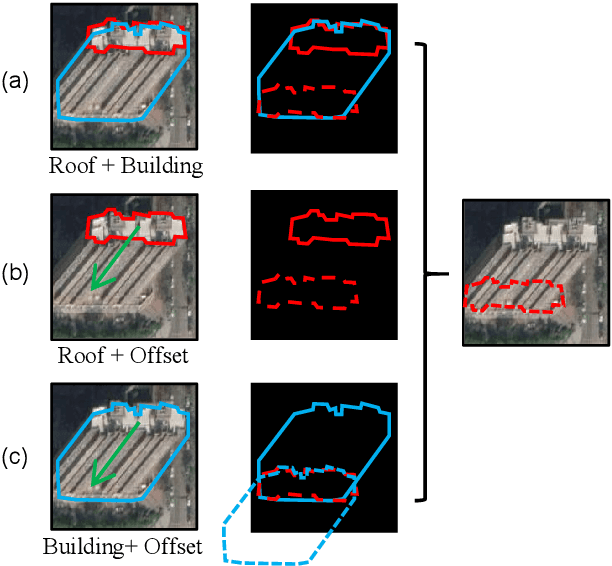
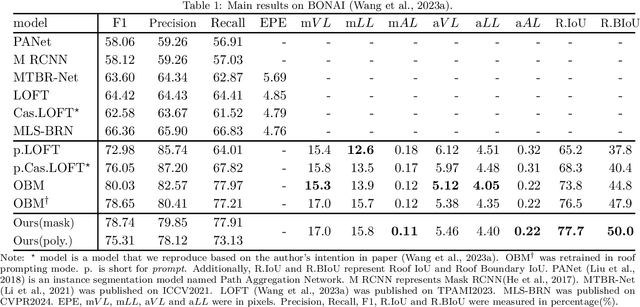
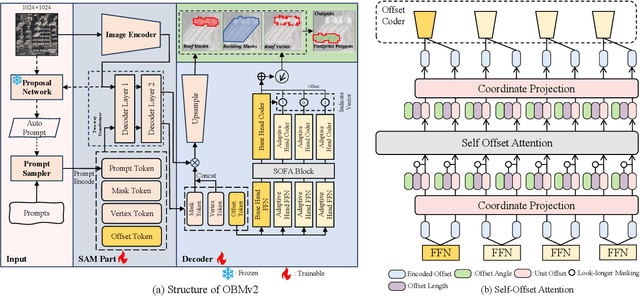

Building Footprint Extraction (BFE) in off-nadir aerial images often relies on roof segmentation and roof-to-footprint offset prediction, then drugging roof-to-footprint via the offset. However, the results from this multi-stage inference are not applicable in data production, because of the low quality of masks given by prediction. To solve this problem, we proposed OBMv2 in this paper, which supports both end-to-end and promptable polygonal footprint prediction. Different from OBM, OBMv2 using a newly proposed Self Offset Attention (SOFA) to bridge the performance gap on bungalow and skyscraper, which realized a real end-to-end footprint polygon prediction without postprocessing. %, such as Non-Maximum Suppression (NMS) and Distance NMS (DNMS). % To fully use information contained in roof masks, building masks and offsets, we proposed a Multi-level Information SyStem (MISS) for footprint prediction, with which OBMv2 can predict footprints even with insufficient predictions. Additionally, to squeeze information from the same model, we were inspired by Retrieval-Augmented Generation (RAG) in Nature Language Processing and proposed "RAG in BFE" problem. To verify the effectiveness of the proposed method, experiments were conducted on open datasets BONAI and OmniCity-view3. A generalization test was also conducted on Huizhou test set. The code will be available at \url{https://github.com/likaiucas/OBM}.
Multi-modal Crowd Counting via Modal Emulation
Jul 28, 2024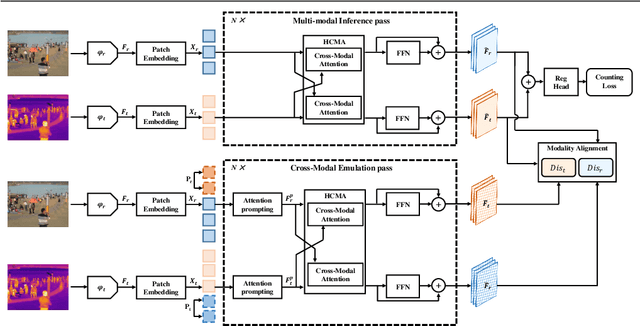


Multi-modal crowd counting is a crucial task that uses multi-modal cues to estimate the number of people in crowded scenes. To overcome the gap between different modalities, we propose a modal emulation-based two-pass multi-modal crowd-counting framework that enables efficient modal emulation, alignment, and fusion. The framework consists of two key components: a \emph{multi-modal inference} pass and a \emph{cross-modal emulation} pass. The former utilizes a hybrid cross-modal attention module to extract global and local information and achieve efficient multi-modal fusion. The latter uses attention prompting to coordinate different modalities and enhance multi-modal alignment. We also introduce a modality alignment module that uses an efficient modal consistency loss to align the outputs of the two passes and bridge the semantic gap between modalities. Extensive experiments on both RGB-Thermal and RGB-Depth counting datasets demonstrate its superior performance compared to previous methods. Code available at https://github.com/Mr-Monday/Multi-modal-Crowd-Counting-via-Modal-Emulation.
Multi-modal Crowd Counting via a Broker Modality
Jul 10, 2024Multi-modal crowd counting involves estimating crowd density from both visual and thermal/depth images. This task is challenging due to the significant gap between these distinct modalities. In this paper, we propose a novel approach by introducing an auxiliary broker modality and on this basis frame the task as a triple-modal learning problem. We devise a fusion-based method to generate this broker modality, leveraging a non-diffusion, lightweight counterpart of modern denoising diffusion-based fusion models. Additionally, we identify and address the ghosting effect caused by direct cross-modal image fusion in multi-modal crowd counting. Through extensive experimental evaluations on popular multi-modal crowd-counting datasets, we demonstrate the effectiveness of our method, which introduces only 4 million additional parameters, yet achieves promising results. The code is available at https://github.com/HenryCilence/Broker-Modality-Crowd-Counting.
RWKU: Benchmarking Real-World Knowledge Unlearning for Large Language Models
Jun 16, 2024Large language models (LLMs) inevitably memorize sensitive, copyrighted, and harmful knowledge from the training corpus; therefore, it is crucial to erase this knowledge from the models. Machine unlearning is a promising solution for efficiently removing specific knowledge by post hoc modifying models. In this paper, we propose a Real-World Knowledge Unlearning benchmark (RWKU) for LLM unlearning. RWKU is designed based on the following three key factors: (1) For the task setting, we consider a more practical and challenging unlearning setting, where neither the forget corpus nor the retain corpus is accessible. (2) For the knowledge source, we choose 200 real-world famous people as the unlearning targets and show that such popular knowledge is widely present in various LLMs. (3) For the evaluation framework, we design the forget set and the retain set to evaluate the model's capabilities across various real-world applications. Regarding the forget set, we provide four four membership inference attack (MIA) methods and nine kinds of adversarial attack probes to rigorously test unlearning efficacy. Regarding the retain set, we assess locality and utility in terms of neighbor perturbation, general ability, reasoning ability, truthfulness, factuality, and fluency. We conduct extensive experiments across two unlearning scenarios, two models and six baseline methods and obtain some meaningful findings. We release our benchmark and code publicly at http://rwku-bench.github.io for future work.